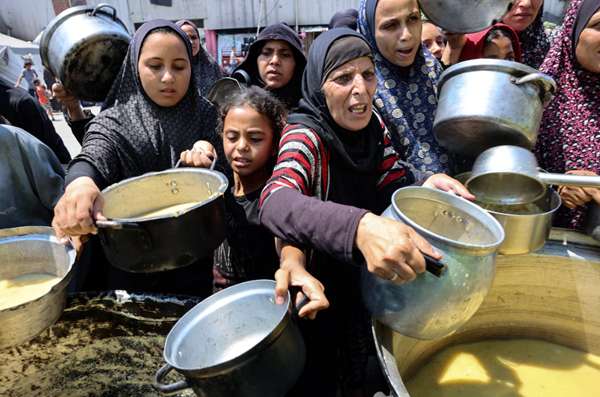
Displaced Palestinians receive lentil soup at a food distribution point in Gaza City in late July. (OMAR AL-QATTAA/AFP/Getty Images)
【LTS / Betty Gu】 As the UK, France, Canada and other Western countries consider unilaterally recognizing a "State of Palestine," it's crucial to note that peace cannot be rebuilt through symbolic gestures alone. Mounting expert analysis and empirical evidence suggest such a move is not only premature but potentially damaging to negotiations, regional stability, and the principles of democratic governance.
1. Palestine Still Fails to Meet Basic Criteria for Statehood
According to the 1933 Montevideo Convention, a state must possess four key attributes: a permanent population,defined territory, effective government, and capacity to enter into relations with other states. Palestine, as it currently stands, does not meet these conditions:
Political division is deep and unresolved: Since 2007, Hamas has maintained control over Gaza, while the Palestinian Authority (PA) governs parts of the West Bank, and has no authority over Gaza or Hamas.
Collapsed political institutions: There have been no national elections since 2006; the Palestinian Legislative Council is defunct, with governance centralized under presidential decree.
Undefined territorial claims: The Palestinians claim East Jerusalem as their capital, but the area is under Israeli control, and no borders have been mutually agreed upon.
Even within the West Bank, OECD data show that local government expenditure fell from 3.7% of GDP in 2016 to just 2.2% in 2018, signaling weak administrative capacity. A divided entity lacking institutional control and rule of law cannot qualify as a sovereign state.
2. Recognition Would Reward Terrorism, Not Encourage Peace
Gaza remains under the authoritarian rule of Hamas,which refuses to disarm, rejects the existence of Israel, and continues to carry out rocket attacks on civilians. The October 2023 Hamas-led assault killed over 1,000 Israeli civilians, including women and children—a clear act of terrorism.
Unilateral recognition of Palestinian statehood would thus be interpreted as legitimizing such violence. As the Australia / Israel & Jewish Affairs Council (AIJAC) noted, it would send a message that“terrorism pays.”
Justice must be grounded in peace, not propelled by rocket fire.
3. Undermining Negotiation Leverage, Destroying Peace Frameworks
Diplomatic recognition must not precede the resolution of foundational issues. Recognizing a Palestinian state outside of bilateral negotiations would strip Western countries of leverage to encourage reform within the PA, weakening incentives for compromise and accountability.
Experts with experience in past Israeli-Palestinian peace efforts warn that recognition "without preconditions" erodes the very foundation of the peace process, particularly the Oslo Accords.Israel has made it clear that such moves are unacceptable and risk dismantling years of fragile diplomatic progress.
4. A Crisis of Governance and Democratic Legitimacy
According to the OECD and United Nations:
The Palestinian Authority has no functioning legislature and is ruled by presidential decree.
Fiscal mismanagement, corruption, and lack of transparency are endemic.
Civic space is shrinking, and public trust in institutions is low.
In Gaza, Hamas’s rule is even more repressive, devoid of human rights, due process, or freedom of the press. A UN humanitarian assessment indicates that all Palestinians face some level of social or economic vulnerability— worsened by the absence of legitimate, responsive governance.
5. Western Divisions and Legal Doubts
Despite political posturing, internal debates across the West expose deep concern:
UK legal experts in the House of Lords argue unilateral recognition may violate international law.
Canadian scholars warn that premature recognition could embolden extremist elements and fuel antisemitic incidents domestically.
French President Emmanuel Macron has remained cautious, insisting that recognition must be“conditional and coordinated.”
As AIJAC outlined in its white paper, “Nine Reasons Recognition Now Hurts Palestine, ”early recognition risks diminishing international legal norms, rewarding division, and weakening reform momentum.
Conclusion: Recognition Must Follow Reform, Not Replace It
While the humanitarian impulse behind recognizing Palestinian statehood may seem noble, it cannot substitute for the hard work of building democratic institutions, establishing governance, and securing peace through negotiations.
Responsible policy should prioritize:
· Hamas’s disarmament and the release of Israeli hostages;
· Palestinian legislative reform, including free elections and anti-corruption measures;
· A revived peace process based on negotiation, not unilateral declarations.
Statehood is not awarded by sympathy. It is earned through accountability, unity, and peace. Recognizing Palestine at this juncture sends the wrong signal — and risks making an already fragile situation even more combustible.
